Dr. David Fraze: What we've been really intentional about is hearing from professors that this will be their last semester with you.
And I'm not saying you will not see them because part of their heart is with us and we will try to invite them into and use their talents in any way that we can.
Because they're part of the lifeblood of who we are and they literally have been walking with students for a long time.
I'm very excited to be able to introduce to you this individual that I've known.
We were backstage trying to do the time.
Since 1992, when he came to town, his kids were at Vandalia.
My friend James was youth minister there, and I was at Green Lawn.
And we got to know this family because they would go back and forth between our groups.
We'd go to camp.
Really got to know them and respect them and love them.
I asked this individual, I'm going to notice the dramatic ramp up.
I asked this individual to tell me a little bit about what he's done.
And he has a long CV and Vita.
I'm not going to go through all that, but I said, what are some things?
He's taught in the Bible department and for the honors college for an estimated 5,000 students.
He's developed the Honors College over 19 years, including managing the growth of 5 million in endowments.
I still get calls, by the way, on my line for people wanting to talk about the Honors program, and I've been sending him messages.
I bet he had my office at one point, too.
Developed the Washington internship program with over 107 interns.
Created numerous campus faith and learning initiatives and brought international scholars to campus.
And we say international scholars, sometimes even as a person who's part of the academy,
I wonder sometimes how in the world did he get them to come to Lubbock, Texas?
We've had some incredible scholars in their fields come to Lubbock, Texas.
And he served on several major national scholarly guild boards.
Dr. Stacy Patti is someone who has cared so deeply about so many things,
our processes, your experience as a student,
our level of engagement with our global community, with our national community.
He has been a champion of those who are under-championed,
and he's been very passionate about it.
One of my favorite things is to watch Stacy do his walk.
If you've noticed, Dr. Patty loves to walk a lot.
He'll work hard, and then he just starts walking around campus,
and he loves to come back to the Bible department,
which I'll just go ahead and say has to be his first love.
And it's not just because we usually have donuts.
He just likes us.
and it's been a gift of mine since I was a young faculty member for Stacy to walk in and shut the
door and just tell me what's going on in his heart and give me direction on the things that were
going on in my heart and he's always done it this is amazing there's some people who should not have
the humility they have Stacy has such a humility about him and I think you've noticed that if
you've been a student of his, if you've been a colleague of his, if you've been a staff member
of his, that he leads with a great deal of humility and a great deal of wisdom. And above
all things, he's an authentic follower of Jesus. Authenticity is a huge thing for me.
And he stood on this stage and talked about his demons and how they formed and fashioned him to
be the man of God that he is today. He lives what he helps us walk every single day. So I think you
know the cue. We're about to give a ruckus and loud welcome, a standing ovation for my friend,
colleague, and one of the greatest parts of Lubbock Christian for his last chapel address,
Dr. Stacy Patty.
Dr. Stacy Patty: This is a fun tradition that Dr. Frey started.
I know it'll be fun to hear a lot of people through the years.
I'm very grateful to be here.
I came to LCC back in 1975 as a biblical languages major and studied biblical languages, was in Kitt I, was a choir member, but very quickly focused largely on being in the library or the Bible building.
If I wasn't working in the cafeteria, I washed dishes in the cafeteria or working at J.C. Penny's.
I was an early morning custodian there for years.
Those were good years.
Came back in 1992 to teach in the Bible department, as Dr. Frey said.
I taught largely everything except Bible after the first few years.
I was the one who taught Greek and church history and philosophy of religion and world religions
and enjoyed that a lot and worked myself out of a position
and then moved into the honors college, honors program, and then honors college.
And in the last five or six years,
began to help with the College of Liberal Arts and Social Sciences.
So I've had a really, really rich time here.
And I'm grateful for the opportunities I've been given,
both to grow and to help and to learn from the mistakes I've made
and the kindness of everyone here.
One of the reasons for my retirement has to do with family.
Family is important.
And as we've aged, we've realized that we have aging parents, and we have working, busy children, and we have growing grandchildren.
It was just last Wednesday that Sherry and I were blessed to have the experience of being close to the birth of our fourth grandchild and first grandson.
It was not easy.
As some of you know, my daughter, Kristen, a 19, well, 8 years ago graduate from here,
one of your fellow alums, had heart failure during the procedure.
And a very rare event happened that's normally fatal for women in the very early stages.
So for several hours, about 18 hours, it was touch and go.
And we weren't sure we would have Kristen back.
And I reached out early in that period to all of you through the administration for prayers and to other people throughout the world who are friends of ours and church members.
And I can't thank you enough for those prayers.
It's always strange how prayers work.
Sometimes they're answered the way we want them to.
Sometimes it takes some time.
We're very grateful.
And as I'm speaking, Kristen is being discharged from the hospital.
So we're very thankful for that.
I wanted to tell you that story because it's appropriate.
It's on our minds.
It's on my mind.
and also because it gave me the opportunity,
sitting in the hospital for the last few days,
to rethink what really matters,
and to rethink what really matters to me
in terms of faith and hope and community,
but particularly to rethink what really matters
in terms of the things I've been wanting to share with you
for a good while now.
And this is over the years,
probably over the 30-plus years I've been here,
These are the kinds of things that kept coming into my mind, that kept being important to me.
And I think I wanted to spend my time today asking you to think about them too.
The first is vocation.
Vocation is that word that we typically place in the category of a job, a career.
And most of us are here at this university because we're preparing for helping others to prepare for a job or a career or a vocation.
And so we take courses and we prepare for that.
And there's some truth to that.
But we all know that the word vocation comes from the word calling or refers to the word calling.
And I think it's important for us to think about that for a second and be reminded that our calling is to come to find out what God wants us to be and what God wants us to do.
And that's not always tied directly to our jobs.
And it's not always tied directly to the paths we take.
So often, I have had to struggle with and help others to struggle with the fact that sometimes,
even if you're good at something, it's not necessarily what you're called to do.
Because you're probably good at a lot of things.
Even if you're sure that what your parents said you should be doing is what you should be doing,
it's what you're going to be doing, who you're going to be.
It's not necessarily the path that leads you to the greatest job, the most success,
the possibility of making the greatest difference.
vocation is is tied up in something much deeper i like the phrase that um frederick buechner uses
when he says that the place god calls you to is the place where your deepest gladness and the
world's deepest hunger meet we know that deep hunger we know that as christians we're called
to help people and to be light and salt for the world and to and to bring good to others we know
that and we want our paths to be with paths that help others, but that's that first phrase,
the place God calls you to is a place where your deep joy is. That deep joy is not something that's
going to always make you smile. It's not something that's always going to make you feel good.
It might be hard from time to time. It might be a long, arduous path. It might be
really, really great for a while and sometimes really stressful, but what we're talking about
here is that place that you would get to where at the end of the day, at the end of the week,
at the end of the month, although it may have been full of all kinds of complications,
you just know this is what you're supposed to be doing. You can't think of anything else.
The place God calls you to is the place where you can't not be. I've struggled with that
through the years here and struggled with helping you all, students, faculty, staff,
Keep thinking along that journey.
It's a journey.
And keep realizing that sometimes the most obvious is not the place that you're going to end up.
And so it's important to be aware of that deep sense of who God is calling you to be and what God is calling you to do.
I'm happy that through the years I think I've kind of found that.
And I hope you can too.
It's hard because along the way we have to deal with our identity.
Identity is one of those ideas that's thrown around a lot, but I'm thinking more in terms
of how we come to know who we are.
When we live in a culture, we come from a society, we come from a tradition that says
we are individuals.
We're part of a world that says that you grow up a certain sort of way and what you're supposed
to do is you're supposed to learn to think for yourselves.
You're supposed to develop your path.
You're supposed to know that you are the one who writes your own course.
You're supposed to know that the people who succeed are the people who pull themselves up by their own bootstraps.
And there's a whole lot of value in you as an individual.
You with your rights.
You with what you most want to do that you think you've got to do no matter what.
This kind of focus upon yourself.
You alone.
you figuring it out
you being the master of your course
is really an unfortunate
falsehood
I am who I am
and you are who you are
because of social identities
and social connections
identity is complex
but it's really rooted
the larger system
and host of different
contexts and situations and inheritances and social functions and
friendships and associations and educational contexts and arguments and counter arguments
who we come to be who we come to know as ourselves is really the result of a whole
host of things, some which we can't even begin to understand or take credit for.
I come from a heritage of blue-collar working families. I'm a first-generation college student.
My father worked in the oil field. My mother was a secretary. My ancestors
are Scotch-Irish and German and Lutheran immigrants who settled in the South
and fought for the Confederacy.
I grew up in really good public schools.
I went to great colleges here and elsewhere,
and I've had really good church family structures
and church supports.
Those things have been really important to who I am.
I've had to deal with the fact
that there are some dark sides to our history.
There's alcohol addiction in my history.
There's all kinds of factors that are part of the world that have made me who I am.
And you've got those stories too.
And you've got those heritages too.
And I hope you can think about those.
I hope you can come to understand those.
Because once we do, once we come to understand those,
the next step that I hope comes is gratitude.
For me, it's been really important to understand that it's sheer blessing that I was born into a good family, raised in a good church.
That my world was not shattered by broken homes, that public education was there and it was rich, and that I was able to come to LCC back in the day.
The host of things that I received, not because of what I did, but because of where I was.
Now, you've got to take responsibility for that.
You've got to act appropriately.
But the truth of the matter is, just like was told to the ancient Israelites, you know, you come into a land you didn't own.
You're taking over a place that wasn't yours.
So much of what we come to see and come to have and come to be are due to factors and influences and people and context that are totally beyond our control.
I hope you can find that gratitude and keep calling on that.
It's really, really, really important.
And it leads us to a kind of humility that I hope we can keep having.
A humility with regard to our own accomplishments.
I tried to say something about that already.
A kind of humility with regard to our own failures.
I've had mine, for sure.
And I've had to deal with bad choices I made
that influenced a lot of people for a lot of times.
Humility in realizing that the things I deserved,
I didn't handle well,
or I haven't done as good as I could with.
Humility with regard to those sheer gifts,
those sheer blessings, those sheer serendipities that come along.
But also humility with regard to others and towards others.
I like to think that through the years,
and I've tried to encourage students to think that,
you know, when you start thinking about it,
a lot of people find themselves in situations
and make decisions that aren't good.
A lot of cultures are quite different from us and may seem to be in some way not appropriately acting or living.
A lot of factors out there can lead us to be judgmental, can lead us to be put off by people that don't work hard or live well or aren't Christian.
can harm us in ways that take us down those paths where we don't want to be.
I think, for me, what I wanted to try to encourage students and staff and friends and the faculty to do
is to try as best we can to realize that there but for the grace of God we go.
we want to help
we want to understand
but first we've got to admit that
most people
are doing the best they can
and most people
have to deal with what they've been given
and I hope that
you understand the context
in which I'm saying that
and if we're really trying to be
it leads us to a kind of place where we want to help.
We realize that the structures of society,
the institutions of schools and churches
and family situations and finances and financial help
are things that some people haven't had
as well as we may have had.
And so we want to try to help that.
We want to try to understand people.
We want to try to keep growing.
Humility doesn't always, doesn't just help us,
in my mind, in a moral sort of way,
but it helps us in an intellectual sort of way.
So we become curious.
I like to encourage myself and you all
to realize that the response to the blessings we've been given
is to try to understand better what's out there
and help make things better for others.
Curiosity is linked to discovery
and it's linked to realizing that we don't know it all and we can't know it all
and we shouldn't try to claim that we've got everything figured out
and that the pictures we have of the world are probably blind in some ways
and that there's just a whole lot out there.
There's a whole lot across the hall.
There's a whole lot across the city that we can't comprehend.
Curiosity leads us to keep discovering, to keep trying to learn.
both in that way but also in ways to help our own
habits of learning.
In my mind, one of the saddest things
about higher education today
is that we have to, for necessity's sake,
focus upon career preparation.
I wish we could just come
and encourage you to follow that instinct.
You see that piece of art
you hear that quote or you watch something on the news and you wonder about that country or that
religion or that new scientific discovery or this trip to the moon that's coming up and
and so you just get involved in learning about it. Take a minor. When you leave here, travel.
Do everything you can to force yourself to develop habits of learning.
There's nothing better to help us develop the virtues of patience and kindness and integrity and prudence
to get towards wisdom on a small way than constantly being curious.
It also helps us grow spiritually, by the way.
Because we as Christians believe that God is the source of all good and the source of all creation.
And so that God is all the source of all truth.
And I want to know truth.
And I want to learn more about God.
And I want to learn how to be a better person and live out my calling better.
And so I want to try to be a person who says, I believe.
Help me understand.
Help me understand everything.
And I hope that you can do that too.
So, vocation, identity, gratitude, humility, curiosity, and in the end, it's just grace.
It's grace that we are able to be here.
It's grace that we know Jesus.
It's grace that we have a rich friendship and a rich community.
It's grace that we have life.
It' grace that we have the ability to learn.
It's grace that we have the ability to serve and care and love and hope.
It's grace to be here.
And I've enjoyed the journey.
Thank you.
Thank you.
applause
Thank you.
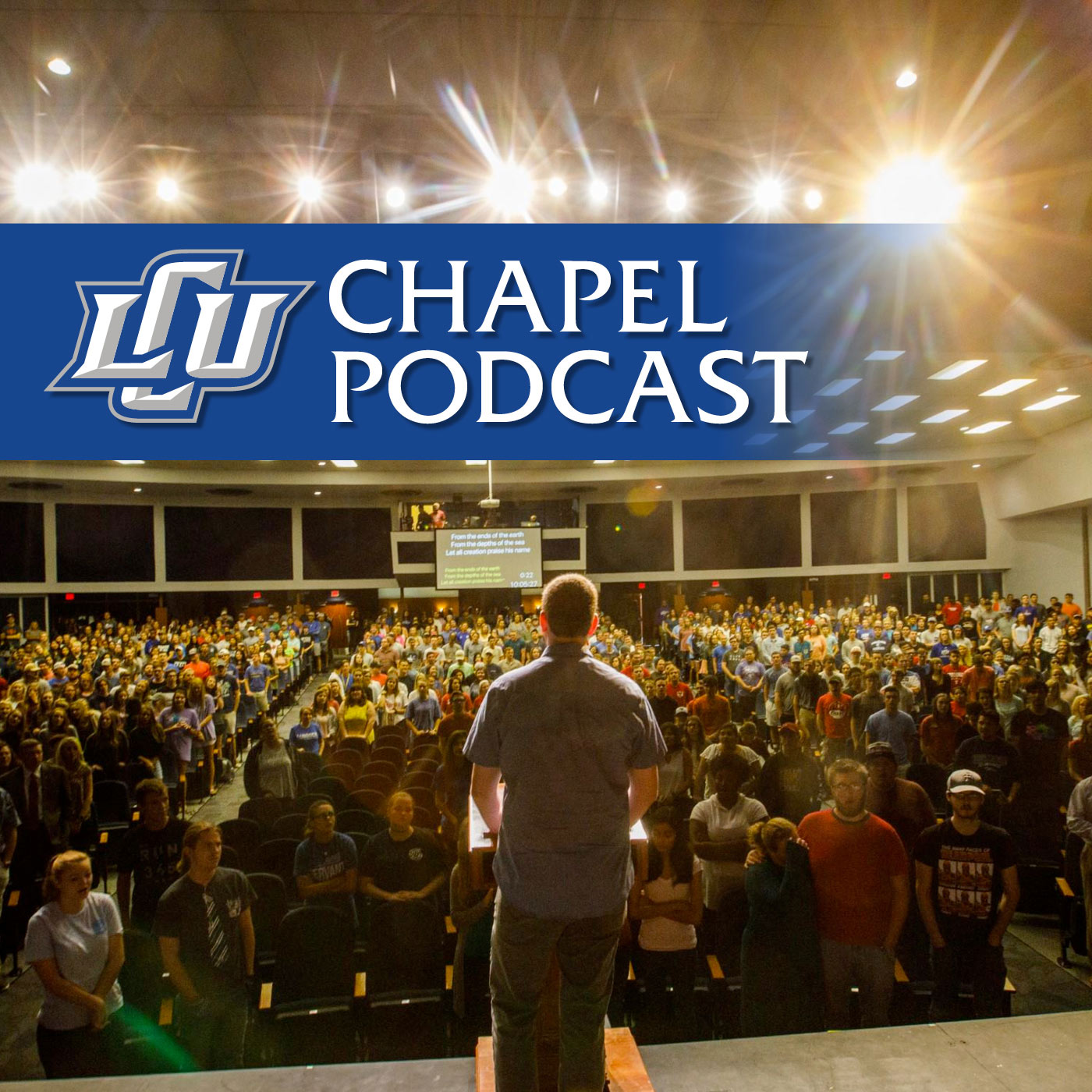
Monday, Tuesday, Thursday, and Friday in the McDonald Moody auditorium, campus family and friends make time for chapel, a time to celebrate relationships. Some chapel times will focus primarily on our relationship with God, while others will focus primarily on community with each other. Many chapel experiences will combine elements of both.
RSSA Life Well Called
Tuesday, Mar 31st, 2026Author : Dr. Stacy Patty
From student to professor, this episode traces one educator’s journey through calling, community, and gratitude and what truly matters at the end of a career.
Episode length 22:57 minutes