Dr. David Fraze: I'm really excited about who's going to be speaking to you this morning, Dr. Jeremy Hagee.
And every once in a while, you get to make an introduction of someone that you've known a long time.
But I've known Jeremy since he was a teenager.
And he is an incredible scholar.
He's our faculty president.
Some of you have had him for class.
He's probably one of the most conscientious professors as far as some of the things he talks about.
So you can see every angle of it.
He wants you to learn.
He wants you to not just learn about Jesus, but how to live that life out in the world.
Now, a cool thing he's not going to tell you.
I had the pleasure of being one of his coaches back in the mid to late 90s.
Folks, he was all city, all district, all state.
It was a big deal.
Go by and look at his helmet.
He kept it.
I know that's weird.
It's kind of fun.
Ladies and gentlemen, please help me welcome Dr. Jeremy Hagi.
Thank you!
Dr. Jeremy Hagi: Well, I wasn't going to tell you all that stuff.
I wanted you all to like me for me, not for all that.
But it's good to be here with you all.
I'm so glad you're here today.
This morning, I was asked to address the question,
why do we celebrate Black History Month at LCU?
And so in doing so, I want to focus my attention on stories.
And where I'm going to begin is I'm going to begin with my story and my family's story.
And I want to ask for some grace and a listening ear from you as I do this.
So stories, they're a part of our personhood, our identity.
We want them to be validated, the good and the bad.
So in 1880, my great-great-grandfather, John Jacob Hagee, left Switzerland.
He stowed away on a ship sailing for New York.
He was discovered halfway through, and he had to work his way off the price of the ship in the kitchen.
And when he got to New York, he had the clothes on his back.
He had no money, and he had an apple in his pocket.
He was a blacksmith by trade, and by 1909, he had worked his way from New York City all the way to Petersburg, Texas.
I don't know if you're all aware of Petersburg, Texas, but it's just right by here.
And there he farmed in the summers, and in the winters he went up to Kansas and worked as a blacksmith in the coal mine.
This is a very short story of a story that I heard all the time from my parents as a kid.
It's a story that stands at the heart of the Hagee family's identity, sacrifice and hard work.
But stories, they don't just inform us, they morally form us.
And the formative action of story, it's a central part of the Old Testament.
In the book of Deuteronomy, the Israelites are just about to enter the promised land,
but their legendary leader, Moses, he wants to remind them of a few things before they get there.
And so he anchors his thoughts with these words from Deuteronomy 6, verses 4-9.
Hear, O Israel, the Lord is our God, the Lord alone.
You shall love the Lord your God with all your heart and with all your soul and with all your might.
Keep these words that I am commanding you today in your heart.
Recite them to your children and talk about them when you are at home and when you are away,
when you lie down and when you rise.
Bind them as a sign on your hand.
Fix them as an emblem on your forehead and write them on the doorsteps of your house and on your gates.
This short passage of scripture and really the whole book of Deuteronomy assumes that we are always being formed by something.
And the question it presses on us is what story is forming us?
Let me give you an example of this.
There's another Hagee family story we tell that's central to our identity.
In the 1960s, my grandpa, Don Hagee Sr., led the effort to fully integrate schools in Petersburg.
This cost him friends.
It cost him his position on the school board.
And so, as you can imagine, this story adds another pillar to our family identity.
We seek to do the hard thing, and we seek to do the right thing.
But there's a reality to the way my family told this story.
It gave me something I could hide behind.
I let my grandpa's work excuse me from understanding and exploring the broader context of racism and segregation that shaped that moment.
So how was I allowing that story to form me?
Did this distance and indifference that began to open up a door of suspicion and fear in my heart, is that what was happening?
Would I allow him to do the work?
I realized listening required more than being from a good family
so I dug deeper into our family history and I discovered that my great-great-grandfather
witnessed the lynching of a black man when he was traveling through Kansas
that discovery it unsettled me it still unsettles me our stories they're more complicated than we
want them to be, but God calls us to look at them honestly, to ask what story is forming me,
and that honesty, it pushes me to listen to the black stories that I hadn't learned.
So we love our neighbor well when we listen to their stories. During that exploration,
I learned that the role that slavery had in shaping the United States, how its legacy,
it just didn't end overnight and how we still feel its echoes in our communities and in our
institutions. And I didn't just learn about slavery. I also witnessed stories of black excellence,
stories of black joy, stories of black complexity. Like the story of Harriet Tubman. Harriet
Tubman's faith was not abstract. It moved her feet back into danger to lead others to freedom.
And her courage showed me that trusting God sometimes means risking everything for someone else's dignity.
Or the story of Frederick Douglass.
Frederick Douglass distinguished between the Christianity of Christ and the Christianity of slaveholders.
In his words, they forced me to ask whether my faith is comfortable or whether it's a faith that moves me to love people well.
And I think about the story of Howard Thurman.
And Howard Thurman was a theologian and mentor of Martin Luther King Jr.
And Thurman gives us a vision of what the kingdom looks like,
especially from the perspective of people whose backs are against the wall.
So he asks us to think creatively and joyfully about the kingdom.
And so the overwhelming effect of learning how to listen to these stories
was that I realized how partial my education had been.
How many faithful, brilliant, and courageous black voices I had never been taught.
And what it did was it put me on a trajectory to love, serve, and see my neighbors more faithfully.
So that's my story.
It's a story of how I got here, but Black History Month, it's not about me.
It's about honoring black stories that are often ignored or erased and receiving them as part of our shared story.
So we catch a glimpse then of the kingdom of God and its fullness when we listen to those stories.
Let me tell you what I mean.
When we listen across our differences, across race, across class, across gender, across culture, we glimpse a vision of revelation.
Revelation chapter 7, 9 through 10, where John paints this beautiful picture of the Lord returned
in his glory and creation renewed. This is what he says, after this I looked and there was a great
multitude that no one could count from every nation, from all tribes and peoples and languages
standing before the throne and before the lamb robed in white with palm branches in their hand.
They cried out in a loud voice saying, salvation belongs to our God who is seated on the throne
into the lamb. It's a beautiful mosaic of human difference and diversity, and it's not flattened
into sameness, but instead it's redeemed into communion, gathered at the feet of God. In the
kingdom of God, dignity is not scarce. Honor is not scarce. Grace is not scarce. The kingdom is
not a competition for dignity. Your story, it doesn't threaten my story. My story matters,
and your story matters too, and so does everyone else's. And so when the kingdom of God is the
story, I'm formed well. When the biblical story becomes the interpretive framework for my life,
I become more like Jesus, and listening well is one step to doing this. So I keep my eyes fixed
horizon to this coming kingdom. And instead of investing myself in the dehumanizing practice
of distance, of suspicion, of indifference, I choose to turn toward my neighbor, listen well,
be uncomfortable, love them well, and catch a glimpse of something better, something that
leaves me in awe. So what do we do with all this on our campus? I want to leave some practices in
front of you. Some practices for listening well and loving our neighbor well. Number one,
it starts with yourself. Notice your emotions and name them when you're in these conversations. How
am I feeling right now? Our emotions have a way of kind of getting in our own way.
So choose humility. Number two, don't formulate your response while you're listening. Be focused
on the person in front of you. Number three, when it's time to ask questions, seek to understand
before you seek to be understood.
Be curious, not judgmental.
Number four, I want you to choose one story,
one story of a black person to learn this month,
one book, one documentary, one biography,
and talk with it about somebody.
And this month, the last thing, again,
ask yourself, what story is forming me?
So listening, it's not the end.
It's the beginning.
It's the beginning of faithful attention
that can lead to repentance, repair,
where possible and real neighbor love.
So why do we celebrate Black History Month?
We celebrate Black History Month
because honoring and listening to black stories
is a Christian practice,
a practice of truth-telling and neighbor love
that prepares us to rejoice in the multi-tribal kingdom
we see around God's throne.
So as you and I are going about our business in the world,
let's ask ourselves,
what story is forming me?
and who have I not listened to yet?
You are dismissed.
applause

Monday, Tuesday, Thursday, and Friday in the McDonald Moody auditorium, campus family and friends make time for chapel, a time to celebrate relationships. Some chapel times will focus primarily on our relationship with God, while others will focus primarily on community with each other. Many chapel experiences will combine elements of both.
RSSHonoring Stories: Black History Month and the Kingdom of God
Thursday, Feb 19th, 2026Author : Dr. Jeremy Hagi
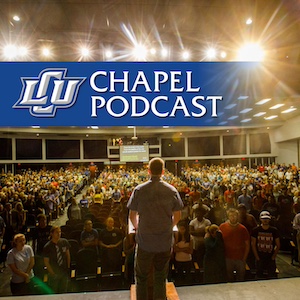
Why do we celebrate Black History Month at a Christian university? Dr. Hagi answers by showing how honoring Black stories is an act of truth-telling and neighbor love—revealing a vision of God’s redeemed, people gathered in grace and dignity.
Episode length 11:30 minutes